
Your Client’s Primary Voice Type Is…

The Underdog
A Voice of Outlook, The Underdog has a hopeful-but-not-confident vibe as they prepare for an uphill battle.
It’s the little guy fighting the behemoth. Davids vs. Goliaths. Cinderella stories in the making, or the little engines that could, chugging their way up the mountain. Choose your own metaphor.
Most Underdogs excel at giving their all — but face some sort of (often major) disadvantage
These guys stand a chance and we love rooting for them. Yet thing to remember is, not all Underdogs win. In fact, they’re not supposed to. But that doesn’t stop them from taking their best shot and we happily cheer them on, because they deserve a victory… even if it never comes.
For every Rudy, Rocky, Erin Brockovich, or 1980 US Olympic Hockey Team, there are tons of people who never reach their goal. But they doesn’t stop them from trying.
Brand Voice Examples of The Underdog In the Wild
Louis CK
Comedian, Actor
Applebee’s
Restaurant chain
Ben & Jerry’s
Premium ice cream
Patagonia
Outdoor & Adventure Gear
Sam Adams
Boston Crafted beer
Another Underdog is James Altucher, who made his writing career about detailing the giant mistakes yet succeeding in spite of himself — and he’s made great strides in his life while readily admitting he hasn’t quite got it right yet.
Comedian Louis CK is another famous (infamous?) example of someone who uses a more downtrodden voice. In his act, he’s “a man falling apart for your pleasure.”
Think of Avis Car Rentals, "We try harder" slogan, a nod to both its lower status, and determination to be the best. Underdogs lack complacency with the current state of things and fight for change.

Common Underdog content:
✏️ Fumbling their way to success stories
✏️ DIY and Self-Improvement Manifestos
✏️ Satirical editorials
It’s worth mentioning that “Underdog” is usually a temporary voice. It’s often a right of passage that’s part of someone’s journey until they put their plan into action. At that point, they either win... or they lose. Remember, Cinderella isn’t sewing her sister’s clothes in a dingy little cottage anymore. She’s a princess in a castle.
On the flip side, some underdogs don’t make it through, at which point they either begin again or move toward a new path.
“Hold up, this is great but it feels like something’s missing…”
That’s because voice isn’t as simple as putting someone into 1 of 9 boxes and calling it a day. And unless they're a robot, your client is likely a combination of 2 or more voice types.
There are more than 511 possible voice type combinations, btw. Waaaay too many to create a comprehensive quiz on. What you have here isn’t a complete solution — it’s a starting point.
Developing mastery in something as complex as voice takes not just time, but practice. (Heck, I've been doing this for years and I'm still finding new things.)
FAIR WARNING: THIS BAD BOY GOES DEEP.
After reading your quiz result, your brain is gonna try and fool you into thinking you know all you need to know when it comes to voice.
That couldn’t be further from the cognitive bias based truth, my friend. In reality, you’re very likely sittin' pretty at the top of child’s hill
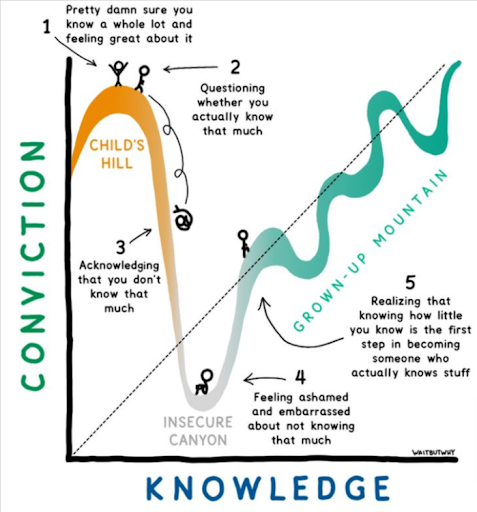
Don’t let the Dunning Kruger effect get you down, baby bird. I’ll help you fly.
Hey, I’m Justin Blackman. I train copywriters to find the perfect-est brand voice (and sometimes make up words.)
I teach voice to copywriters because I want them to avoid the pitfalls that destroyed my early confidence and stalled my career.
Copy by committee was my reality for years. Every project I wrote got watered down again and again while I watched helplessly because I had no way to defend my work. Everyone (and I mean everyone) had an opinion and it hurt my results. That doesn’t need to be your story.
Once I learned this framework for voice, everything changed.

The truth is, most clients care about you capturing their voice more than they let on. And sometimes your instincts around voice are right... sometimes they're not. Either way, the game changes entirely when you make voice a process. Because intuition doesn’t scale.
I’ve written for more than 429 different people and dozens of brands…and all their voices were “unique”
Yet I could mirror them anyway. How? There’s a process to voice. Knowing it will help you stand out, charge more, keep your clients happy, and refine your craft like nothing else. This will make you their most-trusted writer.
Brands I've helped:









Ready to meet the brand voice basics?
Get to know the 3 main components of voice
VOCABULARY
TONE
CADENCE
Vocabulary
Simply put, vocabulary is the words you use. It’s how you communicate.
Less simply put (or more eloquently) "vocabulary is the prose you select to convey your intent, communicate your knowledge, and transfer ideas among people using a collection of words shared between a community."
TELL ME MORE
See how that first definition is easier to read? It feels more consistent with everything you’ve read here so far. Doesn’t mean the second definition is wrong — it's just… different.
Heck, maybe you even read it with a British accent. Non-native English speakers often overlook the subtle connotations between synonyms. “Said” vs. “Claimed” vs. “Uttered.” All these words have similar meanings but different connotations that you pick up over time.
When someone “claims” something, it can subtly imply they’re lying or wrong — but the dictionary won’t tell you that.
“She said we’d be paid” vs. “She claimed we’d be paid.” These subtle differences can make huge differences in voice.
Vocabulary also includes the readability of your writing. Are you using longer, more advanced words, or simple phrases? Big vs. gargantuan? Use vs. utilize? Thingy vs. cutting-edge revolutionary digital solution?
While some articles recommend you should write around a grade seven reading level (meaning a 12-year-old could read it), others say you should aim below grade three (meaning an 8-year-old could read it).
As for what’s REALLY ideal? It depends on your market. If you’re targeting customers for a one-off purchase like a supplement or an ebook, then maybe grade seven or below will be most effective.
If you’re writing a quick check-in to a client, you might write more basic. But if you strive for a long-term relationship with a more advanced consumer, you might want to write more robustly.
For example, if most of your audience are established business owners and you want intelligent customers, simple writing might be a turnoff for them. It may appear too basic. But if your writing is more comprehensive and complex, it might show you’re the perfect fit.
And remember, turning off the wrong audience can absolutely be a good thing.
The same goes for jargon. Most writing advice is to avoid industry insider language, but to the right people, it acts as a credibility identifier.
For instance, in the cheese world, a true cheesemonger would never describe a cheese as “sharp.” They’d say “acidic” or “lactic” or “aged.” If you use the more common term of “sharp” when marketing to a true cheese head, you’ll immediately mark yourself as an outsider and lose trust.
This doesn’t mean you should write complex sentences just for the heck of it. Even with an intelligent market, simple is almost always better. You’re not “dumbing it down” — you’re making it more readable. You’re letting the message have more power than the words. You’re not making readers burn calories to decipher your message... and you’re being respectful of their time.
Tone
Tone is easy to understand and easy to recognize. You can usually find the tone by asking two questions: “how is the author feeling?” and “what is the author’s personality?”
Answers include: frustrated, sarcastic, aggressive, empathetic, sad, impertinent, flippant, or joyful... among many, many, many others. (SRSLY. There are hundreds.)
Tone is the emotional backdrop to voice. It can stay consistent through the piece or change depending on the subject or character development. It can even change over the course of the framework you’re writing with, such as Problem/Agitate/Solution. (Troubled, frustrated, optimistic. The tone goes from dark to darker to light.)
TELL ME MORE
Tone in writing is just like tone in speaking — but it can be trickier to convey. Jokes are especially tough and humor can be lost entirely. We’ve all had those moments where a sarcastic text message gets lost in translation and misinterpreted by the receiver. It can lead to some awkward conversations.
It’s also easy to let our own emotions accidentally affect tone — like when we reply to a boss or a client who’s irritating us. While our words may be professional, our tone can often cause problems. “Per my last email...”
Notice how each of these following phrases make you feel...
BOSS: Will you be attending today’s meeting?
YOU: Yes!
Yes...
Yes.
Yeah
Yes?
Yes
yes
Affirmative
Yup!
Yuppers.
👍
Notice any vibes coming from the punctuation, casing, or formality? That’s tone.
It’s difficult to recognize tone in our own work because we’re reading the text in our head with our own inflections. We hear it as we want it to sound. But the reader doesn’t always hear it the same way. That’s why it always helps to have others review your work (even emails when they’re important ones) to make sure there isn’t an underlying tone you may be missing.
Love ‘em or hate ‘em, emojis can be a huge help here. But we’ve all seen people who rely on them as a crutch. The real mastery comes from being able to convey tone without them. (Pro-gamer move.)
Want to see this in action? Grab a friend and play Name That Tune. Tap (don’t hum!) the beat to “Happy Birthday” on a table and ask them to guess the song. You’ll be dumbstruck that they can’t get it because, while you hear the changes in pitch in your head, they only hear a monotone beat. If by some chance they do guess correctly, it’s because they recognize the cadence.
Cadence
Cadence is the rhythm of the writing — the flow and length of your sentences — and it’s the most subtle piece of the voice equation.
Often, when you have work that requires multiple authors in one piece, it’s the cadence shifts that are the most noticeable.
Dramatic shifts in cadence are like riding shotgun in a stick-shift car with a new driver — you’re gliding along smoothly when suddenly, wham! You feel a violent jerk.
TELL ME MORE
(Rudy from sales just put his hand on your knee.)
You jolt.
Cadence is created with a combination of sentence length and word choice. Some writers (like me) have a staccato-type cadence. They write short sentences. Choppy. Lots of periods. Few commas. Fast pace. Lots of jabs.
Others have a more flowing, musical, and rhythmic cadence with longer sentences that go on and on and on and often connect multiple ideas that convey continuous streams of thought as if they’re lost in the idea and you’re on the journey with them, speeding up and slowing down, clinging to every word, searching for meaning, preparing for the end and bracing yourself until finally both you and the writer, commingled in the prose, fancifully reach the conclusion together.
Shorter cadences can convey urgency. Show frustration. Sporadic thinking. Sometimes aggressiveness. While longer cadences usually give a more peaceful, relaxed, and serene feeling. (Though not always.)
Shorter cadences can convey urgency, frustration, sporadic thinking, or sometimes aggressiveness, while longer cadences usually give a more peaceful, relaxed, and serene feeling (though not always.)
Read those two paragraphs again. Did you feel the difference? Intentional shifts in cadence can create drama in a piece to highlight important moments.
For example:
Today I was walking along the sunlit streets of Manhattan, enjoying the majestic shadows created by the towering structures overhead, when suddenly a clumsy man with unwieldy elbows passing by collided with my arm causing my coffee to tumble.
Not cool, man. Not cool. At all.
However, I brushed off the moment and continued my stroll, determined to have a pleasant morning.
This example is a noticeable and intentional shift in cadence that illustrates the interruption in the author’s morning. The long, flowy opening sentence is interrupted by three short, choppy sentences. And then, they quickly shift back to the original cadence. It paints the image of someone strolling along — then stopping abruptly — then continuing again.
Cadence in writing is easy to overlook but it’s massively powerful. For the record, the average sentence length in English is between 15-20 words, with most copywriters hovering toward the lower end.
Shorter sentences may be easier to read, but they become monotonous if the rhythm never changes. The most interesting writers vary up the cadence to keep readers engaged. It’s like the 3:05 mark of Queen’s Bohemian Rhapsody when it turns from a ballad to an opera, then jumps again with the guitar riff at 4:09 to arena rock.
Cadence is the difference between Derek & The Dominos classic rock version of Layla vs. Eric Clapton’s unplugged session that lulls you to sleep.
Same words. Same notes. Different cadence.
Voice, tone, and cadence — three elements, countless combinations
Vocabulary, tone, and cadence. You can combine these three elements in countless different ways to adjust any voice and you can literally plot them on a graph. Yet even with an endless way to blend them, they can almost all fit into 9 Primary Voices. But first...
What Voice Is Not
❌ Voice is NOT personality. Voice is the expression of personality.
❌ Voice is NOT static. It can evolve and change over time.
❌ Voice is NOT just an art. It’s a science and a process you can learn.
❌ Voice is NOT just words. Design can communicate voice too.
❌ Voice is NOT described through 3 adjectives and an avatar. Voice is granular and when well defined, it fuels long term growth (both yours and your client’s)
“Dude, this is complicated. Can’t I just plug my client’s voice info into ChatGPT with a killer prompt and call it a day?”
AI, AI, A-OMG.
Let’s talk about the artificial elephant in the writer's room.
“Style is the stuff you get wrong” - Neil Gaiman
We don’t write “textbook.” If we did everything would be 15-word sentences, AP style, same biases, same goals same words. AI is trying to be the perfect balance of everybody and be a watered-down version of what is "right." It's aiming squarely for the middle. It's trying to be average. You get stuff wrong. That's what makes you great.
AI might get some stuff wrong, but... not the same stuff as you.
Can it follow your style with the right programming? Sure. Will it get there eventually? Maybe. But you’re reacting to real time events, you’re constantly changing, and you're constantly trying new stuff. AI will get to the spot where it can write the content you don’t want to write — but not the stuff you’re passionate about.
And that's what people want to read.
With a good system in place, a copywriter trained in voice can do it waaaaay better.
Now that you know your client’s dominant brand voice, what next?
First off, you can take this quiz more than once. Use this resource for all of your existing clients to impress their pants off and whenever you have a new client project.
Want to go deeper and get your nerdy self one step closer to voice mastery? As a thank you for taking this quiz, you can get yourself a comprehensive training where I’ll show you…

This On-Demand Workshop Gives You Quick-Yet-Helpful Ways To Measure, Mirror, And Codify Voice
(Without Screwing Everything Up)
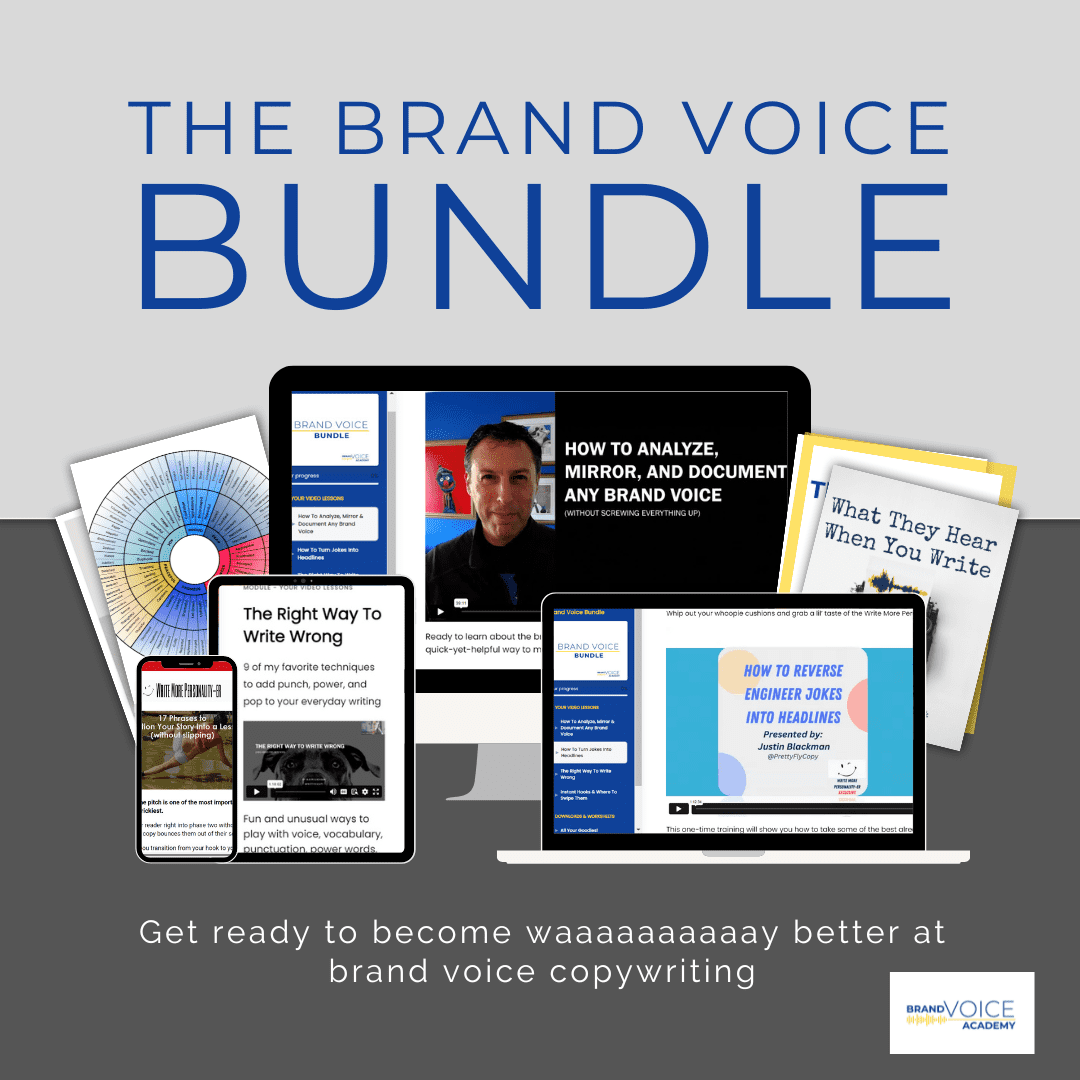
Inside this workshop you’ll learn even more about:
- Vocabulary, tone, and cadence: the 3 musketeers of brand voice mastery
- The 1 tool every copywriter needs to measure and plot a brand voice
- The 9 voice types and a system for how to identify which ones your client best matches
- Why people hate the word ‘m____’ and the power of word associations the dictionary doesn’t touch
- How to know exactly what to do and fix when a client says “this doesn't sound like me”
- An intro to what goes into a voice guide (+ how to sell them)
- The 3 brand voice levers of each voice type
You’ll Also Get Access To Some Seriously Hefty Bonuses
(Each individually worth more than the cost of admission!)
VOICE BONUS #1
93 Email Sign-Offs For Maximum Hilarity
Looking for an easy fix to make your emails more memorable? These 93 plug-and-play personality boosters are a simple way to end emails with a bang and leave your readers with a smile.
VOICE BONUS #2
17 Transitions Lines For Buttery Smooth Story Flips
Flipping from your story to the pitch is one of the most important elements in your content. But It’s also one of the trickiest. Use these 17 simple phrases to turn any story into an asset while keeping your readers on the page.
VOICE BONUS #3
Turn Jokes Into Headlines
This one-hour video shows you how to take funny joke structures and use their pre-packed power as fuel for great, unusual, already-optimized, eye-grabbing headlines.

VOICE BONUS #4
Instant Hooks
Have ‘em at hello with these 6 not-common tips for finding great hooks. These neverending swipe ideas make your copy punchier, more delightful, and instantly engaging through ways most writers will never know exists.
VOICE BONUS #5
Easy Formatting Tricks For Punchier Copy
Use these 8 style and grammar flicks to make your words way more (insert goal here)-ier. I’ll show you my favorite formatting tips to make just about any piece of content a little lot better.
...Plus extra tools from my free e-book, "What They Hear When You Write" — that show you more ways to turn your quiz results into a practical, tactical, and unbelievably useful system.